
Financing the Excluded: How LAFRICOOP Is Unlocking Capital for Refugee Entrepreneurs Details
Financing the Excluded: How LAFRICOOP Is Unlocking Capital for Refugee Entrepreneurs
In Nairobi’s informal economy, thousands of refugee and host community entrepreneurs wake up each day ready to work, trade, and grow. They have skills, ideas, and the determination to succeed, yet they remain locked out of formal financial systems. The barrier is not a lack of capacity, but a lack of access. Without collateral, credit history, or recognized financial identity, even the most viable small businesses struggle to secure the capital needed to grow. This persistent exclusion continues to limit economic mobility and reinforces cycles of vulnerability across communities. LAFRICOOP was created to confront this challenge directly.
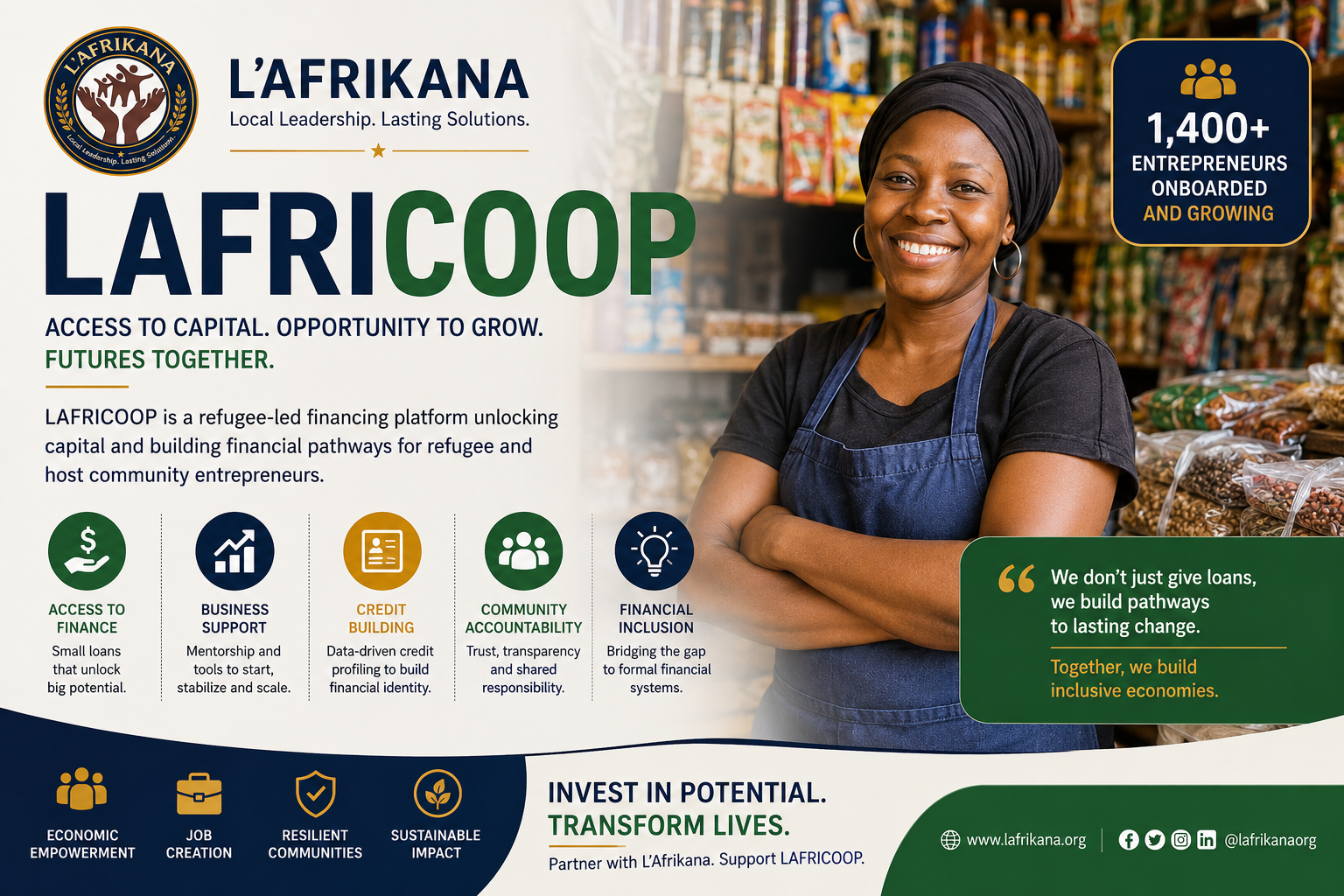
LAFRICOOP is a refugee-led financing platform developed by L’Afrikana to expand access to capital for underserved entrepreneurs. It is built on a clear understanding of the realities faced by refugees and low-income business owners operating in informal markets. By combining micro-lending, business support, and data-driven credit profiling, the platform creates a structured and practical pathway for entrepreneurs to start, stabilize, and scale their businesses. Rather than treating refugees as passive recipients of aid, LAFRICOOP positions them as active economic agents capable of driving their own growth when given the right tools. What distinguishes LAFRICOOP is not only its provision of capital, but the system that surrounds it. Entrepreneurs receive small, tailored loans that match the scale and stage of their businesses, ensuring that financing is both accessible and relevant. Alongside this, the platform delivers financial literacy training, mentorship, and continuous support, while embedding community-based accountability mechanisms that strengthen trust and repayment culture. Through consistent data tracking, participants begin to build credit profiles, gradually transforming informal economic activity into recognized financial behavior. This process allows entrepreneurs to move beyond survival and begin establishing long-term financial credibility. The platform is already operating at scale, with over 1,400 entrepreneurs onboarded and actively engaged. This is not an early-stage concept, but a validated system built on real demand and community trust. These entrepreneurs represent a significant and largely untapped economic segment, demonstrating strong potential for business growth, income stability, and local job creation. Early outcomes indicate increased productivity, improved household resilience, and stronger economic cooperation within communities, reinforcing the viability of the model.
LAFRICOOP aligns closely with global priorities advanced by institutions such as the World Bank and UNHCR, particularly in advancing financial inclusion, economic self-reliance, and the localization of development solutions. By channeling resources into a refugee-led system, the platform contributes to strengthening micro and small enterprises, expanding access to inclusive financial services, and empowering women and youth as key economic actors. It offers a practical framework for transitioning from aid dependency toward sustainable economic participation. At this stage, LAFRICOOP stands at a critical point of growth. The model is proven, the demand is established, and the foundation for scale is already in place. What is required now is strategic investment to expand its reach and deepen its impact. With the right support, the platform can increase its lending capacity, strengthen its data and credit systems, and build stronger linkages with formal financial institutions. This would enable thousands more entrepreneurs to access capital while positioning LAFRICOOP as a bridge between informal economies and formal financial markets. LAFRICOOP represents more than a financing mechanism; it is the foundation of an inclusive financial system designed from within the community it serves. L’Afrikana invites donors, partners, and institutions to invest in this model, supporting the transition from exclusion to opportunity. By doing so, they are not only funding businesses, but contributing to a broader shift toward economic dignity, resilience, and sustainable development. When capital reaches those who are ready to use it, the impact extends beyond individual enterprises, shaping stronger and more inclusive local economies.
-
Call Us
-
Email
-
