
JEMBE LAMAMA: Planting Resilience, Harvesting Dignity Details
JEMBE LAMAMA: Planting Resilience, Harvesting Dignity
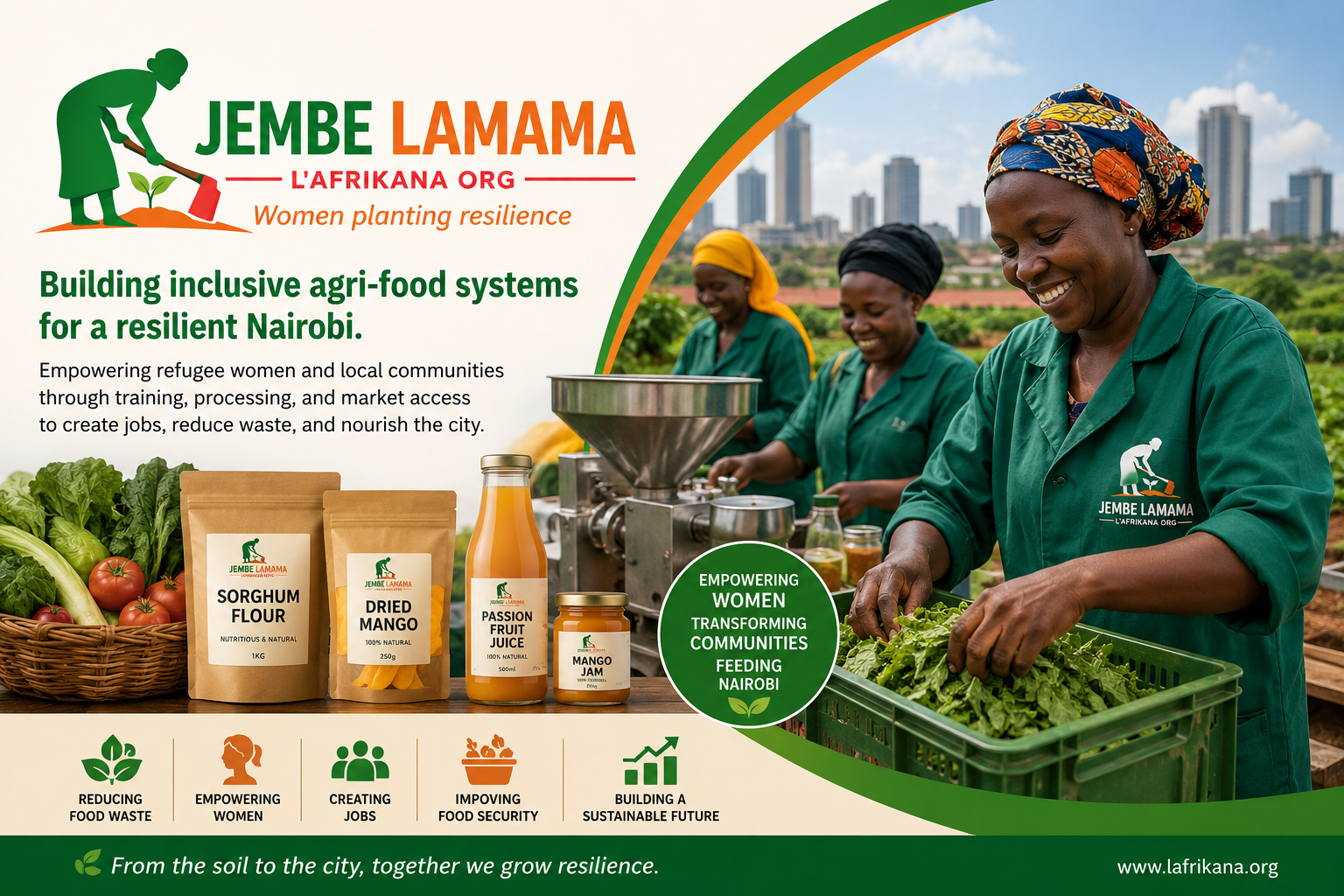
JEMBE LAMAMA, an initiative supported by L’Afrikana Org, emerges as a grounded and practical response to one of Nairobi’s most pressing contradictions: a city rich in agricultural production yet constrained by weak food systems that fail to connect supply, processing, and access. The logo itself captures this vision with clarity—a woman tending to a young plant, symbolizing not only labor but ownership, growth, and the deliberate act of building resilience from the ground up. It reflects a philosophy where transformation is not delivered externally but cultivated through local effort, knowledge, and opportunity. In Nairobi’s rapidly expanding urban environment, food insecurity is not driven by scarcity alone but by inefficiency within the value chain. Agricultural produce from peri-urban areas often goes to waste due to a lack of processing and preservation infrastructure, while urban populations continue to face high food costs and inconsistent access to nutritious products. At the same time, refugee communities, despite possessing strong agricultural knowledge, remain largely excluded from structured economic systems, operating within informal and limited spaces that restrict their potential . JEMBE LAMAMA addresses this disconnect by positioning itself as a bridge, linking production, processing, and consumption into a coherent and inclusive system.
The initiative moves beyond traditional humanitarian responses by establishing a localized agri-food value chain that transforms raw agricultural products into durable, market-ready goods such as flour, dried fruits and vegetables, juices, and other nutritious items. This approach not only reduces post-harvest losses but also increases the availability of affordable food within the city, ensuring that value is retained locally rather than lost along fragmented supply chains. By doing so, JEMBE LAMAMA converts an existing inefficiency into a structured economic opportunity that benefits both producers and consumers. At the center of this system are refugee and vulnerable women, who are intentionally positioned as key economic actors within the project. Through targeted training in agri-food processing, cooperative management, and entrepreneurship, these women gain access to tools, knowledge, and organized markets that enable them to move from subsistence-level activity into stable income generation. This shift represents more than economic participation; it reshapes social dynamics by reinforcing dignity, agency, and leadership within communities that are often marginalized. Alongside them, urban youth are integrated into the initiative, creating pathways for employment in green sectors and reducing the risks associated with unemployment and social exclusion . JEMBE LAMAMA also distinguishes itself by addressing a critical gap within Nairobi’s humanitarian landscape. While many organizations focus on essential services such as health, education, and emergency support, relatively few have invested in building structured agri-food processing systems. This absence has left a significant portion of the food value chain underdeveloped, limiting both economic growth and food security outcomes. By entering this space, the initiative not only fills a neglected niche but also introduces a model where humanitarian action and economic development reinforce one another rather than operate separately. The project’s market approach is equally pragmatic, ensuring that its outputs are aligned with real urban demand. By producing affordable, nutritious, and locally processed food products, JEMBE LAMAMA strengthens local markets while reducing dependence on expensive imported goods. Its distribution strategy relies on accessible channels such as community markets, partnerships with organizations, and localized networks, allowing products to reach populations that need them most without creating barriers to access.
Beyond its economic and nutritional contributions, JEMBE LAMAMA serves as a platform for social cohesion by integrating refugees and host communities into shared systems of production and cooperation. This inclusive model reduces tensions, builds trust, and creates a sense of collective ownership over both challenges and solutions. It reflects a broader shift in development thinking—moving away from isolated interventions toward integrated systems that address multiple dimensions of vulnerability simultaneously. The initiative’s scalability further strengthens its relevance. Starting with a modest pilot structure that includes processing units, training programs, and cooperative networks, JEMBE LAMAMA establishes a foundation that can expand across Nairobi and be replicated in other urban centers facing similar challenges. Its reliance on local resources, community knowledge, and adaptable systems ensures that growth is both sustainable and contextually grounded. In a time when food systems across Africa are under increasing pressure from urbanization, climate variability, and economic inequality, JEMBE LAMAMA offers a model that is both practical and forward-looking. It demonstrates that resilience is not built through temporary relief but through systems that empower people to produce, process, and participate in their own economies. For donors and partners, the initiative presents a clear investment case: a low-entry, high-impact model that addresses food security, job creation, women’s empowerment, and social inclusion within a single, integrated framework . Ultimately, JEMBE LAMAMA embodies the idea that meaningful transformation begins with something small but intentional. Like the seed in its logo, the project represents the early stage of a larger system—one that has the potential to grow, sustain, and reshape how urban resilience is built. It is not simply an intervention; it is a structured pathway toward dignity, stability, and long-term development driven by the very communities it serves.
-
Call Us
-
Email
-
